2026 Beijing Auto Show: China's Intelligent Driving Is Defining Global Standards
2026 Beijing Auto Show: China's Intelligent Driving Is Defining Global Standards
As the global automotive industry's center of gravity shifts eastward, an unprecedented industry showcase has launched in Beijing. From 4/24 to 5/3, the 2026 Beijing International Automobile Exhibition opened its doors as the world's largest auto show, presenting cutting-edge automotive innovation to global audiences and exhibitors. As some international media noted, this edition marks a turning point—the industry is evolving from electrification toward intelligent mobility. Today, Chinese automakers with comprehensively upgraded "full-industry-chain capabilities" are no longer content with leading domestically; they are now looking toward broader overseas markets. At the exhibition, languages from multiple nations converged, signaling that China's automotive sector is poised to become the new global benchmark for innovation, development, and trends in the auto industry.
More than half of the faces in front of the booth were foreign.
The 2026 (19th) Beijing International Automotive Exhibition, themed "Leading the Era, Smarter Future," opened on 24 of 4, attracting over 1000 domestic and international exhibitors. Thousands of exhibitors and visitors will flood the venue over ten days. "One of the world's largest auto shows has kicked off in Beijing," reported Nikkei Asia. With rising fuel costs driven by the ongoing conflict between the U.S., Israel, and Iran, alternative energy sources have become more attractive than ever. Against this backdrop, this year's Beijing Auto Show highlights China's rise as a key force in electric vehicles, poised to lead the next era of intelligent competition.
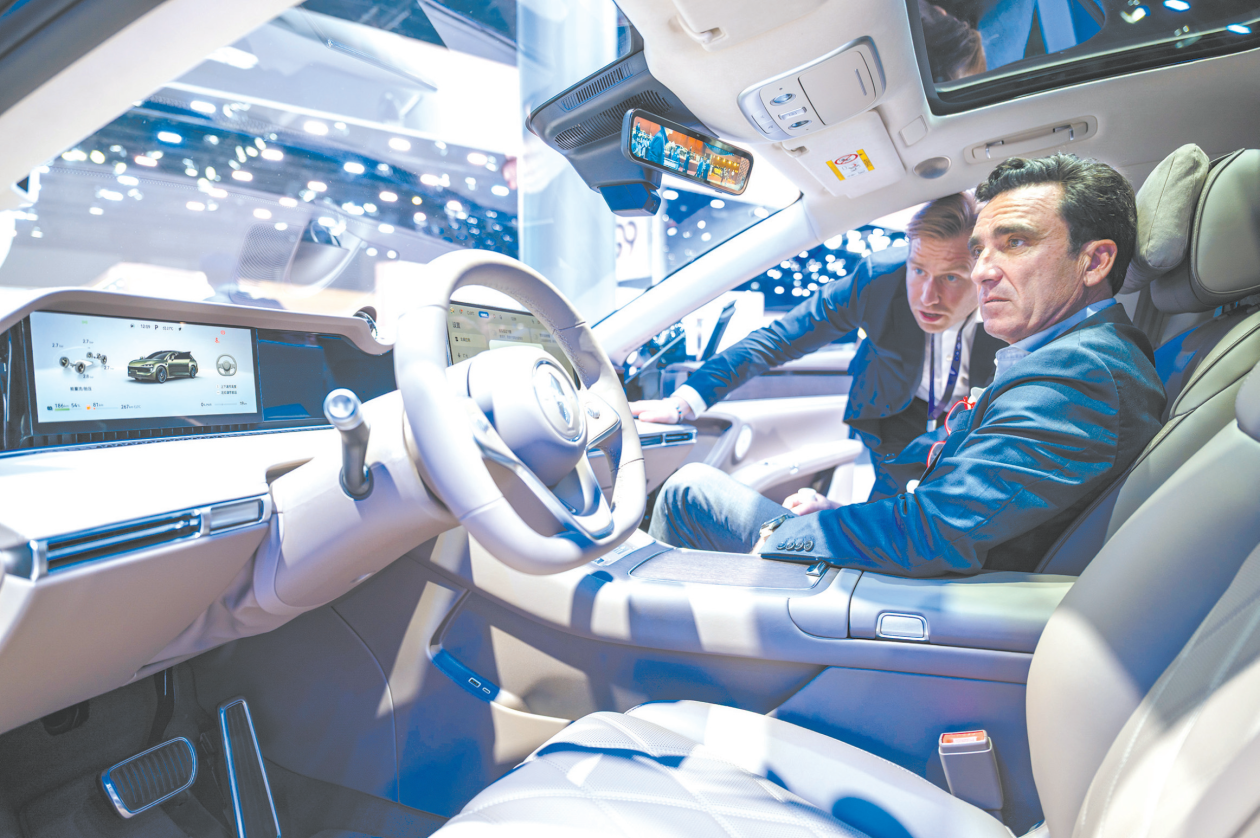 On 24, foreign guests experienced Chinese new energy vehicles equipped with intelligent driving systems at the Beijing Auto Show. (Visual China Group)
On the opening morning of the auto show, multiple Chinese car brands unveiled major new products. Dongfeng Motor showcased a powerful lineup featuring 26 key models, 13 cutting-edge technology exhibits, and a brand-new concept vehicle, comprehensively covering sub-segments including luxury smart off-road, premium new energy, mainstream family vehicles, and multi-functional mobility. At the XPeng booth, the popular XPeng GX model took center stage alongside the latest generation human-like robot IRON and the "Land Aircraft Carrier" modular flying car. A Global Times reporter observed that more than half of the visitors at the exhibition were foreign faces.
"I'm under a lot of pressure!" After the press conference, XPeng Motors Chairman and CEO He Xiaopeng half-jokingly told Global Times reporters, "I have several global launches scheduled for the second half of this year, all in English." Over the past year, XPeng has opened three new factories overseas, added one R&D center, and established more than 40 sales centers. This year, XPeng plans to continue expanding its global footprint with new factories and R&D centers.
What do international customers at auto shows care about most? He Xiaopeng replied that both Chinese and overseas supply chain partners are highly focused on XPeng's long-term global strategy, hoping to jointly build a worldwide supply chain and excel in globalization. Additionally, topics related to safety and technology remain key areas of interest. Many overseas dealers immediately tested XPeng's VLA intelligent driving assistance system upon arriving at the booth. Foreign customers openly praised XPeng's flying cars and humanoid robots, describing them as "surprising" or "captivating." "I believe that combining advanced technology with robust safety, a strong brand, and high-quality products—alongside a long-term vision for mutual success in overseas markets—will enable more Chinese companies to truly go global," He Xiaopeng concluded. Chen Kaixin, a researcher at the John L. Thornton China Center at the Brookings Institution, recently wrote in the UK Financial Times that China has achieved a major turnaround in technology through steadfast implementation of industrial strategies, prompting Western companies to increasingly seek collaboration with Chinese firms.
"The proportion of international visitors at this year's Beijing Auto Show was even higher than at last year's Shanghai Auto Show." Zheng Yun, a Global Senior Partner and Head of Automotive Business for Asia at Roland Berger, expressed the same sentiment on 24 while speaking to The Global Times reporters at the show. He analyzed that China is the world's largest single automotive market, with no other market matching its sheer scale. Thoroughly understanding the Chinese market can resolve many issues related to business models and vehicle sales volumes, yielding "significant amplification effects." Whether they are original equipment manufacturers (OEMs) or parts suppliers, companies clearly aim to make their mark in China. Zheng revealed that foreign clients currently focus on two core advantages of the Chinese market, which his firm summarizes as 'China cost' and 'China speed.' The former refers to leveraging China's supply chain more effectively to reduce costs, while the latter involves learning from Chinese parts makers or OEMs how to accelerate operations in daily practice. For instance, traditional automakers like Volkswagen and Toyota once found it hard to imagine completing a vehicle development cycle in under two years; four to five years was their long-held golden rule. However, Chinese automakers have not only broken this pattern but also achieved high market acceptance, with consumers eager to give new brands a chance. Today, a development cycle of two to two-and-a-half years has become the industry's new benchmark.
At this year's Beijing Auto Show, BYD exclusively occupied the entire E3 Hall of the China International Exhibition Center (Shunyi) in a full-venue takeover. "Customers from any country recognize Chinese new energy vehicles for two key reasons: electrification and intelligence," said Luo Hao, Assistant General Manager of BYD's Brand and Public Relations Department, in an interview with Global Times at the venue. He noted that in recent years, there has been a clear shift in how traditional automotive powerhouses like Europe increasingly praise Chinese car brands. "In the first half of the new energy vehicle era, users' most immediate feedback was that electric vehicles respond faster than fuel cars, with superior acceleration and mechanical performance. As we enter the second half focused on intelligent capabilities, this gap will only widen." Citing BYD's DiPilot system as an example, Luo stated that over 285 million BYD vehicles equipped with driver assistance features are now on the road, generating more than 1.8 billion kilometers of driving data daily for backend analysis. Luo emphasized that massive data is the foundation of intelligent development; without scale, future technological gaps will become even more pronounced. "Traditional automotive companies in Europe and the U.S. struggle to accumulate data at the same scale as BYD during their transition to intelligence, meaning the technological divide ahead will grow significantly."
From "Key Export Destination" to "Global Innovation Engine"
What does the Chinese automotive market mean to foreign automakers? The answer has quietly shifted in recent years. Thanks to technological innovations in batteries, autonomous driving, and smart cockpits, as well as strengths in production and supply chains, China is evolving beyond a "key export destination" into an "innovation engine" in the eyes of global automakers.
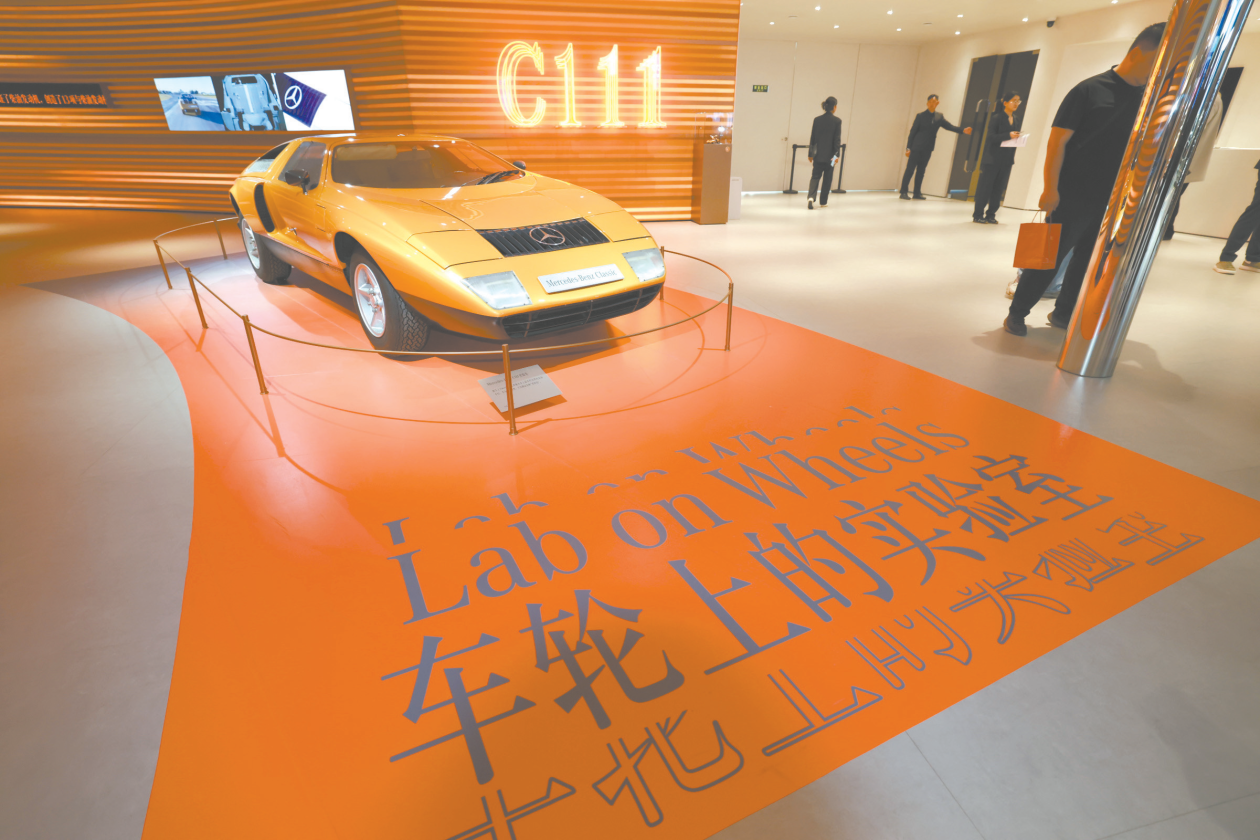 On 24, historic Mercedes-Benz models were showcased at the Beijing Auto Show. (Visual China)
"China is now the core engine of our global innovation," said Christian G. Schaller, President and CEO of Beijing Benz Automotive Co., Ltd., in an interview with The Global Times ahead of the 2026 Beijing Auto Show. From intelligent cockpits to advanced driver assistance systems, numerous technologies are being developed by Chinese teams and are leading the pace of global innovation.
Mercedes-Benz's move is far from unique. At the Beijing Auto Show, Global Times reporters observed that an increasing number of foreign automakers are shifting their R&D focus toward China. On 4 month 17, Audi and SAIC Motor officially signed a strategic cooperation agreement to establish a new Audi Innovation Technology Center in Shanghai. Toyota is also upgrading its Chief Engineer system in China, expanding its elite team from 4 to 7 members. Toyota stated that future localized new products led by Chinese teams will continue to be launched.
"China is becoming a global hub for innovation and exports," said Guillaume Cartier, Nissan's Chief Performance Officer 24, in an interview with Global Times and other media outlets. According to the UK's Financial Times, Western automakers are now trying to maintain competitiveness in China—the world's largest auto market—by launching new electric vehicles powered by Chinese technology, while also aiming to export these models to other international markets.
The "identity shift" in China's auto market is driven not only by corporate technology but also by evolving consumer demand. Chinese buyers increasingly seek smarter, more diverse vehicle experiences, pushing foreign automakers to innovate. At the Beijing Auto Show, Li Jie, Chief Engineer of Toyota RAV4 and Wildlander for China, stated that Chinese consumers now view cars as "partners who understand them," moving far beyond their original role as mere transportation tools. He believes this pursuit of intelligence has positioned China as a global frontier for automotive industry transformation.
Stefan Bratzel, Member of the Board of Management of Audi AG for Sales and Marketing, told Global Times that compared to other global markets, China shows the highest demand and enthusiasm for new technologies. This has driven Audi to adjust its strategy in China by strengthening partnerships with more local collaborators, such as CATL, and UI/UX technology companies, thereby expanding its local ecosystem. At a press event at the exhibition booth, Hyundai Motor CEO Mu Ho-jae stated plainly: "China is defining the future direction of mobility."
Against this backdrop, the division of labor between Chinese and foreign automakers is shifting. According to The Financial Times, while Chinese brands once learned automotive manufacturing from Western competitors, the dynamic has now reversed: overseas automakers are relying on Chinese partners and supply chains to rapidly produce vehicles equipped with advanced software. Herbert Diess, Chairman of the Board of Management of Audi AG, told Global Times that they are seamlessly integrating German engineering expertise with China's innovation. "Over the past few decades, we have learned much from the Chinese market, including how to accelerate development and collaborate effectively. We have even accumulated extensive experience in parallel development across Germany and China, turning it into a competitive advantage."
Leo Sanchez, a Brazilian race car driver and Forbes-listed billionaire, is the sole owner in Brazil of one of only 30 limited-edition Yangwang U9X vehicles worldwide. In interviews with media outlets including Global Times, he stated that Chinese brands have invested heavily in design and engineering R&D, and their current product capabilities now rival those of top global automakers. From environmental and economic perspectives, he noted that electric vehicles help combat climate change; combined with Brazil's abundant renewable energy resources, promoting EVs benefits both the local economy and environment. He highlighted BYD's rapid growth in the Brazilian market, with its market share expected to continue expanding—a clear sign of rising consumer acceptance of Chinese electric vehicles in Brazil.
"Exporting vehicles produced in China to the global market is a key strategic direction for Peugeot's future collaboration with Chinese automakers," said Alain Fave, Global CEO of Peugeot, in an exclusive interview with The Global Times. "Peugeot's new energy vehicles manufactured in China are planned for markets outside Europe, complementing models produced locally in Europe." "Our partnership will follow a model of specialized division of labor: the Chinese team will focus on technology implementation and market adaptation, while the French side will oversee design and driving quality, ensuring alignment with both global standards and local Chinese market needs," Fave added. He emphasized that the Chinese market will serve as a global testing ground and innovation incubator for Peugeot, potentially feeding back into the development of future global models.
"To break the monopoly, become a champion in your niche."
With new model launches, technology unveilings, and market strategies rolling out at an unprecedented pace, the 2026 Beijing Auto Show has become a global stage for automakers. Yet beyond the product hype, this year's event marked an unprecedented collective showcase by automotive supply chain companies—revealing the core of China's auto industry evolution: growth momentum is shifting from "building great cars" to "strengthening the entire supply chain." This isn't just the internal logic of industrial upgrading; it's the true foundation enabling Chinese automakers to compete globally.
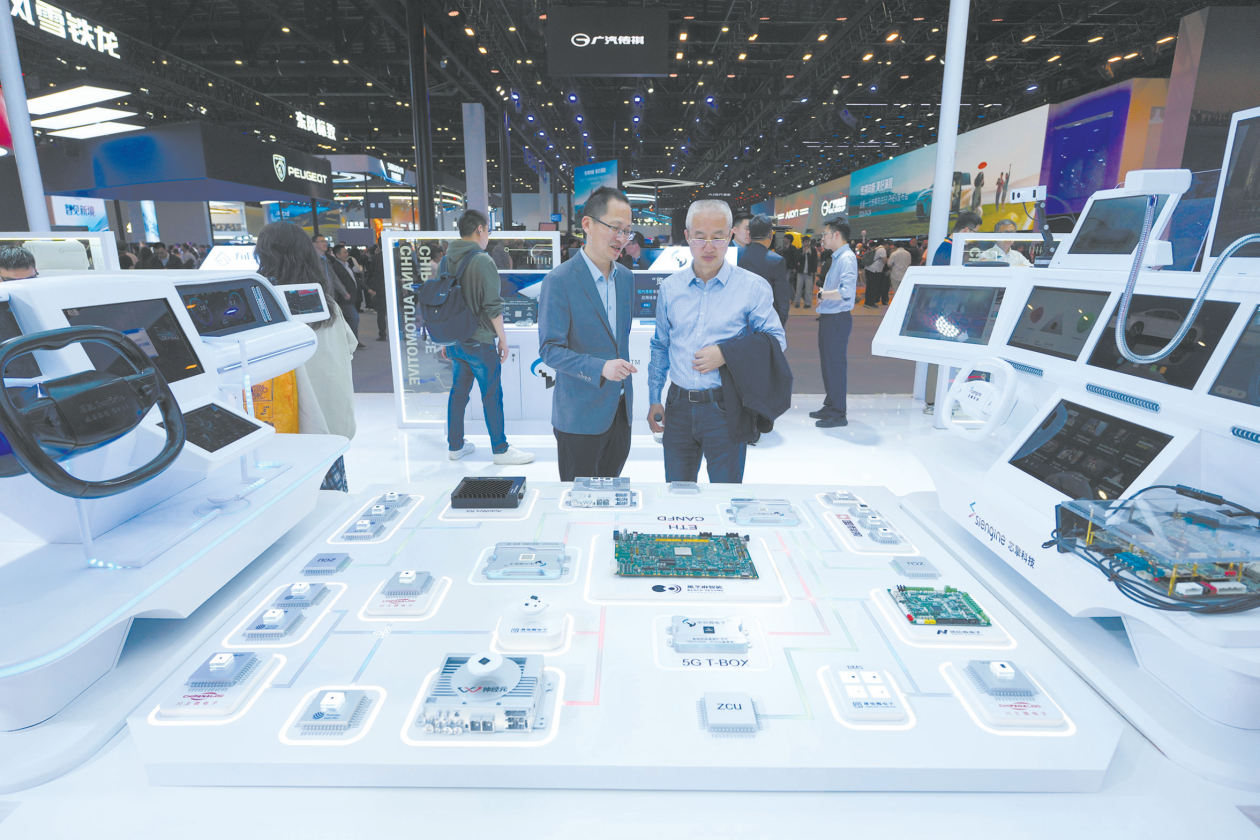 24 Visitors focus on domestic automotive chips showcased at the Beijing Auto Show. (Visual China Group)
"The Zhangxue motorcycle, which just won the World Superbike Championship, is powered by our automotive-grade chip," said Li Yang, a strategic committee member of NaviInfo, an intelligent driving solutions company. He told The Global Times that Zhangxue's cockpit and instrument cluster chip solutions were supported by NaviInfo and have been proven on the racetrack. "We deliver superior fluid interaction and modern display experiences compared to foreign competitors, all at a competitive cost, helping Chinese motorcycle brands achieve technological breakthroughs in international racing," Li added. Similar success stories can be seen across other domestic brands, highlighting the core value of homegrown chips: no over-specifying, no price inflation, yet delivering experiences unmatched by overseas vendors at accessible price points.
The Chinese automotive chip market was once dominated by foreign giants. Industry data shows that in 2023, the penetration rate of domestic vehicle chips remained low, with some independent automakers constrained by overseas supply chains, limiting both costs and pricing power. By 2026, this landscape may be reshaped. At this year's Beijing Auto Show, over 40 mass-produced models were equipped with domestically developed chips, marking a steady rise in domestic chip penetration. From display pieces behind glass to components integrated into mass-produced vehicles, China's automotive chip industry has successfully transitioned from technical breakthroughs to commercial deployment, emerging as a core competitive advantage in the smart vehicle race.
Ahead of the auto show, domestic automakers and chip firms have delivered impressive results in achieving chip autonomy. FAW unveiled the "Hongqi 1", China's first automotive-grade multi-domain fusion chip, integrating intelligent driving, cockpit, body control, connectivity, and safety into a single unit—marking a breakthrough for domestic central computing platforms. NIO developed its own 7nm intelligent driving chip, positioning itself among the global top tier of high-end automotive chips. GAC has even launched the world's first mass-produced vehicle featuring 1004 chips with 100% local content.
At the same time, in specialized segments, a wave of "single-item champions" is reshaping the global landscape through technological breakthroughs. "The overseas automotive chip supply chain has matured its supporting markets through decades of collaboration with major international players," said a representative from Rofic Semiconductor at the China Automotive Chip Alliance booth. "For Chinese automotive chips to break monopolies, they must become leaders in their specific domains." The company's HSMT SerDes chips have shipped over 3000 million units in just over a year, capturing more than 10% of the domestic market share.
In an interview, Li Yang stated that, overall, the core advantages of domestic automotive chips lie in their stability, reliability, supply assurance, and extreme cost-effectiveness. They achieve a "disruptive" lead in the international market for vehicles priced around 3 thousand USD. Compared to traditional giants, domestic automotive chip companies have adopted a strategy focused on breakthroughs at key points, enabling affordable models to deliver smooth, intelligent experiences. Many cockpit chips with "Chinese DNA" are referred to as "game-changers for going global" within China's automotive industry.
"The localization of automotive chips goes beyond breaking foreign technological monopolies; it drives an industry revolution for the global market," said Zhou Xiaoyang, President of Guangzhou Xinjuneng Semiconductor, in an interview with Global Times. Previously, high pricing by foreign chipmakers directly increased production costs for domestic car brands, constraining their global competitiveness. As domestic chips are increasingly adopted at scale, many foreign brands have been forced to cut prices in response, significantly reducing overall vehicle costs. This trend is pushing advanced intelligent driving features from luxury add-ons into mainstream price segments, compelling premium brands to lower their own prices and enabling consumers to enjoy smart mobility experiences at more affordable rates—achieving 'equality' in automotive consumption.
This auto show sends a clear signal: joint-venture brands are now adopting Chinese smart solutions. China is emerging as a global enabler of underlying intelligent vehicle technologies. According to the Global Times, Momenta—a Chinese autonomous driving startup—reports that in joint R&D with Mercedes-Benz, BMW, and Audi, Chinese smart driving solutions have integrated with German rigorous standards, achieving mutual improvements in safety design, extreme environment adaptability, and localization. With its rapid iteration and pragmatic innovation, the Chinese approach has earned recognition from top international automakers and elevated Chinese smart driving technology onto a broader global stage. Yu Kai, founder of Horizon Robotics, another autonomous driving startup, told reporters that accelerating digital transformation by overseas traditional automakers presents global opportunities for Chinese companies. Chinese firms are capable of building the foundational layer combining chips and intelligent systems, participating in setting global standards for the intelligent automotive industry platform, and evolving from supply chain participants into rule-makers.
Source: Global Times